Best Frontline Employee Apps in Australia (2026)
Quick answer to what are the best employee apps for frontline staff in Australia right now.
For businesses with staff across many sites and shifts, CentricMinds is the employee app built to make every shift feel part of the company. Updates reach the right people on their phone, read tracking means nobody finds out last, and pricing is published, from US$5.40 to US$9 per user per month billed yearly. Workvivo by Zoom is a social feed for global enterprises. LumApps and Beekeeper offer one global vendor for desk and frontline. Blink is an app first option popular in transport and health. Staffbase suits large enterprises with dedicated comms teams. Oak Engage suits mixed office and frontline workforces, and Interact suits large organizations wanting a traditional enterprise intranet.
Stop sending mystery messages
People crave knowing, even when they say they don't.
You know the feeling. A calendar invite from your boss that just says "Quick chat," and a night spent imagining the worst.
For frontline staff, the same feeling comes from company news. A roster changes without warning. A restructure gets mentioned in the group chat. A customer asks about a store closure before anyone official has said a word.
In July 2026, an Australian graduate nurse described receiving a morning phone call asking why they hadn't arrived for work. When they checked their online roster, they discovered a shift had been added during their days off.
In another Australian nursing discussion that month, an employee described being expected to check an online roster regularly because shifts could change without direct notification.
These are individual stories, not proof about a whole industry. But the point is clear:
Posting information isn't the same as making sure people know it.
When it's about your pay, your next shift or your job, not knowing hurts.
What your tools say about your company
Every company describes itself well on its careers page. Employees judge it by what happens at work: how they're welcomed, whether leaders explain decisions, whether anyone notices good work, and whether they can see a future there. Even the tools you hand them send a message.
Picture a new starter's first day. Instead of a proper welcome, they're added to a WhatsApp group. It works for quick chats, but it can't give them company news they can trust, a way to be thanked or a sense of where the business is heading.
An employee app can give every employee those things, including people on the shop floor, out on the road and on the night shift. It should work around their day, not ask them to work around the software.
The leadership blind spot
Leaders mostly see the business through reports and meetings. Those can look fine while a store team hears about a change from a customer, or a carer can't find the latest policy.
Here's a simple test:
If your frontline staff described your company based only on last week at work, would it sound like the company you think you run?
How people experience work every day is your employer brand, whatever your careers page says. An app won't fix that on its own, but it makes the everyday basics visible: clear updates from leaders, thanks for good work, a way to speak up and a way to grow.
Why uncertainty gets under our skin
Here's something most leaders don't realize: the fear of losing your job can take a serious toll on your mental health, even if you never lose it. A review of studies from the US and Europe found that feeling insecure in your job was linked to depression slightly more strongly than being unemployed. (American Journal of Epidemiology) And Australian researchers who tracked working Australians over 14 years found that any stretch of ongoing job insecurity harmed their future mental health. (Social Science & Medicine, 2024)
Leaving people unsure isn't a small thing. It's a health risk.
For frontline employees, uncertainty can start with something as ordinary as a message that never arrives. A restructure rumor in the group chat. A roster change nobody explained. A store closure staff hear about from a customer. You can't promise every job is safe. But you can stop people worrying about things that aren't happening, and tell them early when something is.
And Australian workers are already stretched. Gallup's State of the Global Workplace 2026 report found that half of Australian employees experience daily stress, on par with the most stressed workforces in the world. (Gallup, 2026)
The gap is widest on the frontline:
72% of upper managers feel positive about changes at work. Only 46% of frontline workers do.
That's from the American Psychological Association's 2025 Work in America survey. (APA, 2026) And PwC's 2026 Global Workforce Hopes and Fears survey found that 18% of workers affected by change don't understand the reasons for it. (PwC, 2026)
When updates are missing, people start asking: Has my shift changed? Is my job safe? Does this policy apply to me? Why hasn't anyone told us?
Sometimes management doesn't know the answer yet.
Silence doesn't stop the questions. It just means people answer them for themselves.
And that's where rumors start.
The fix is simple, and it's advice good managers have always given: put the point at the top.
The military calls it BLUF, bottom line up front. Say what's happening first, then why, then when people will hear more.
That last part matters more than it looks. A date gives people something to hold on to, even if it's only when the next update is coming.
Mystery message: "Roster changes coming next month."
Clear message: "Weekend rosters at the Geelong store change from 1 November because of new trading hours. Your manager will share your new roster by Friday."
Copy this: the three-line update
- What's changing: [what] at [site or team] from [date].
- Why: [one plain reason].
- What happens next: [who] will [do what] by [date]. Questions? [where to ask].
If you don't know the answer yet, say so, and give a date for the next update. "We don't know yet. We'll update you by Thursday" beats silence every time.
A good employee app lets you send the same clear message to every site and every shift, without relying on word of mouth.
Frontline employee apps compared
Below, we compare CentricMinds (ours), Workvivo, LumApps and Beekeeper, Blink, Staffbase, Oak Engage, Interact and Connecteam, and say where each fits best.
What would it cost for your team?
Enter your headcount to see the yearly cost for every vendor that publishes its prices. No sales call needed.
CentricMinds: where every shift belongs
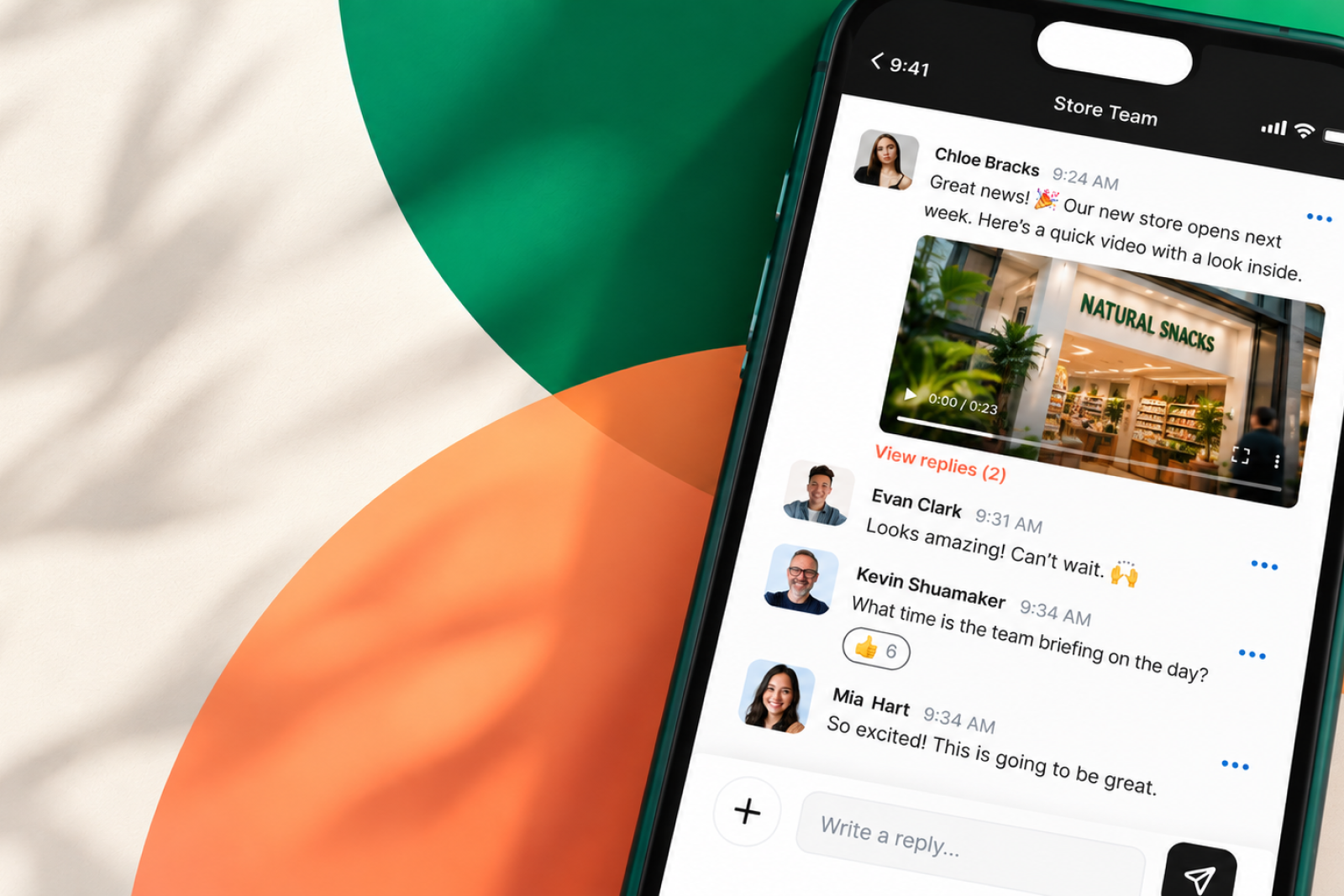
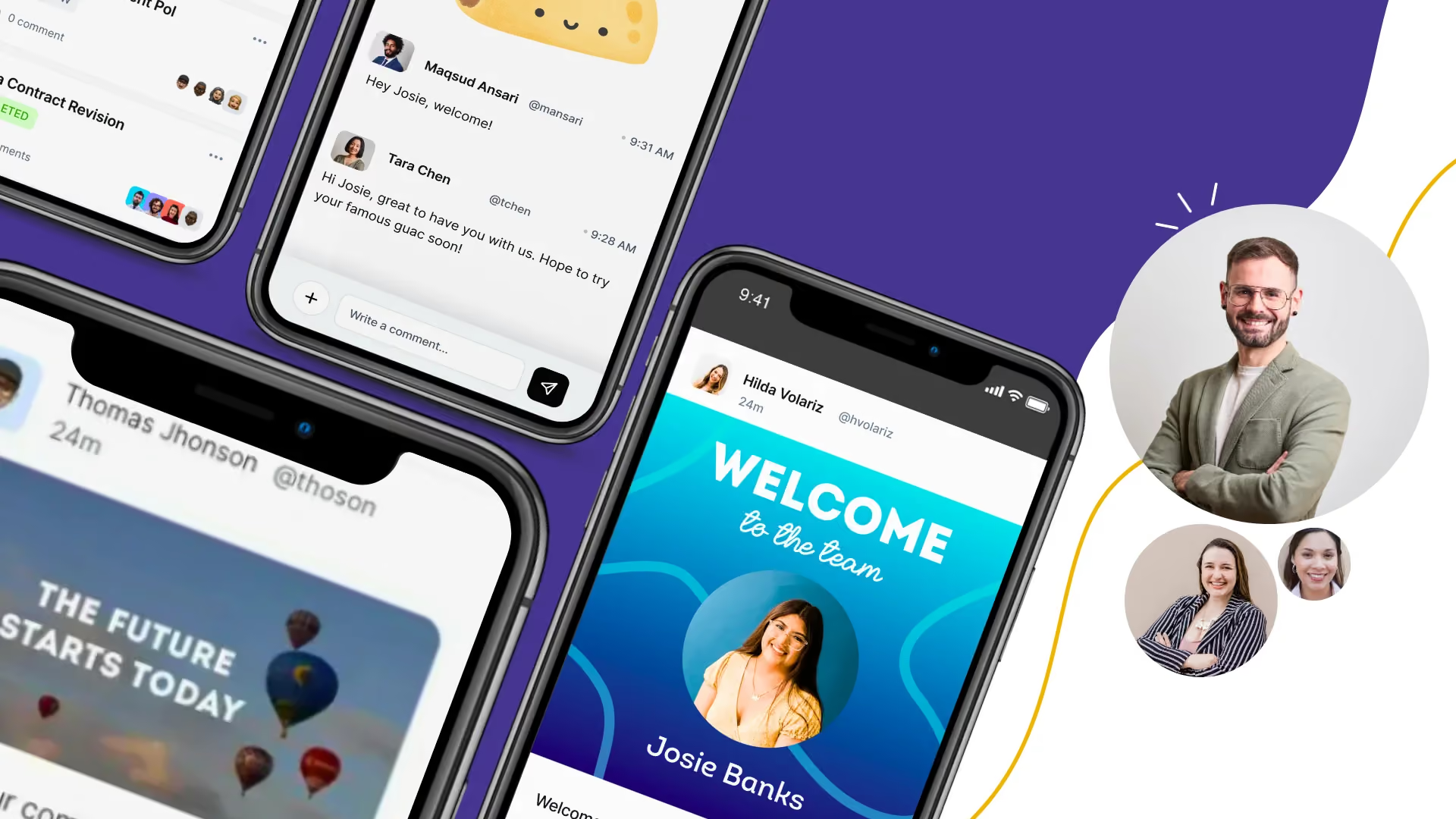
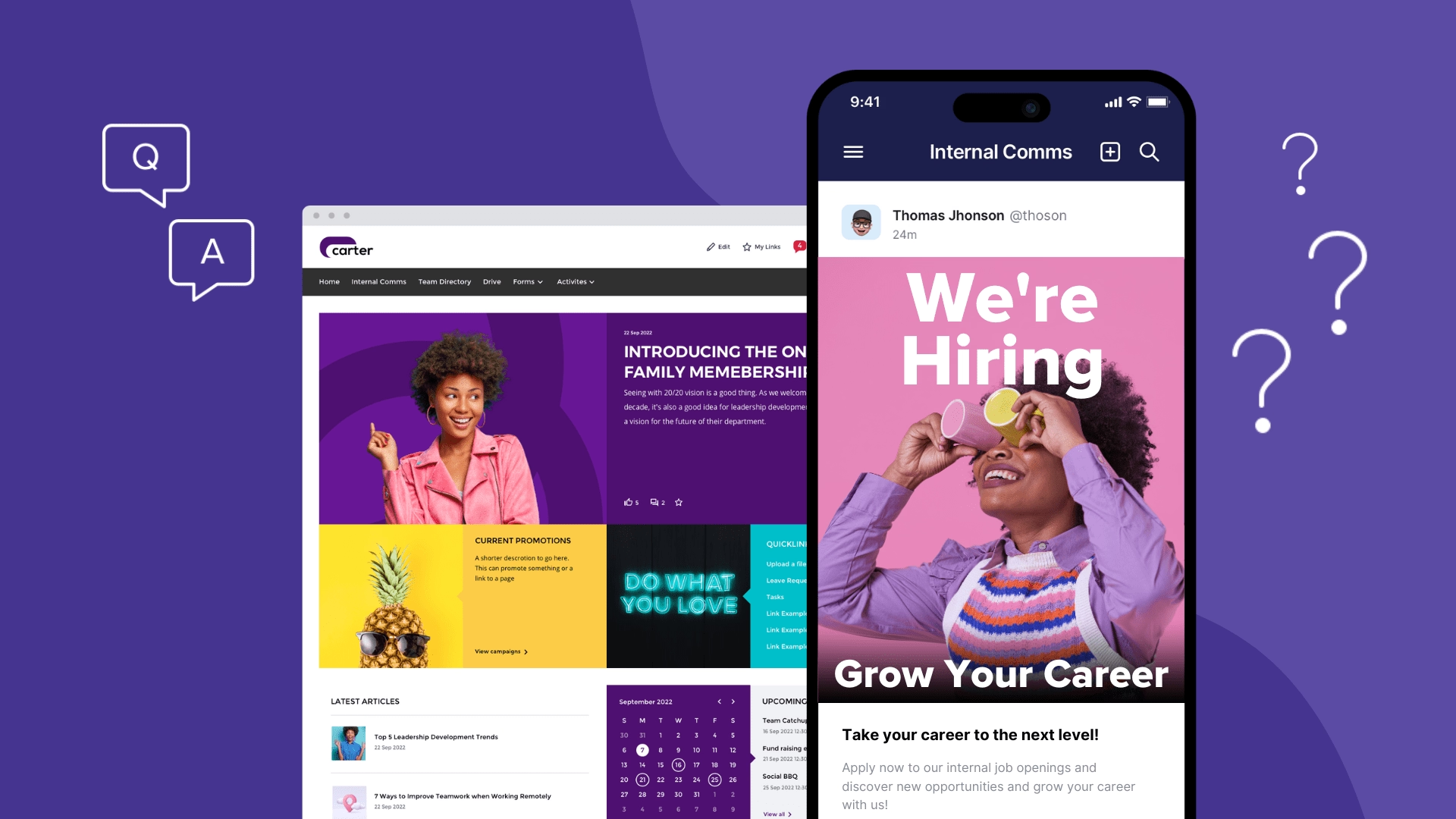
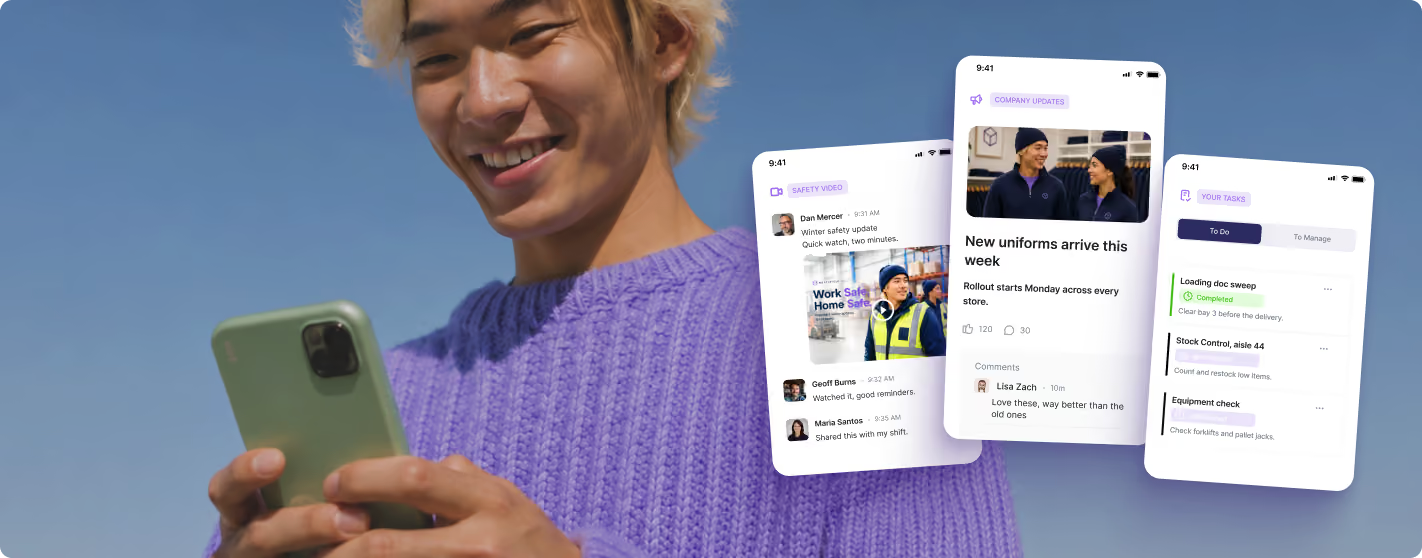
A branded employee app on every frontline phone, with desktop access for head office, so the night shift hears what's happening when head office does. News, policies, documents, forms, tasks and team chat, all in the same app.
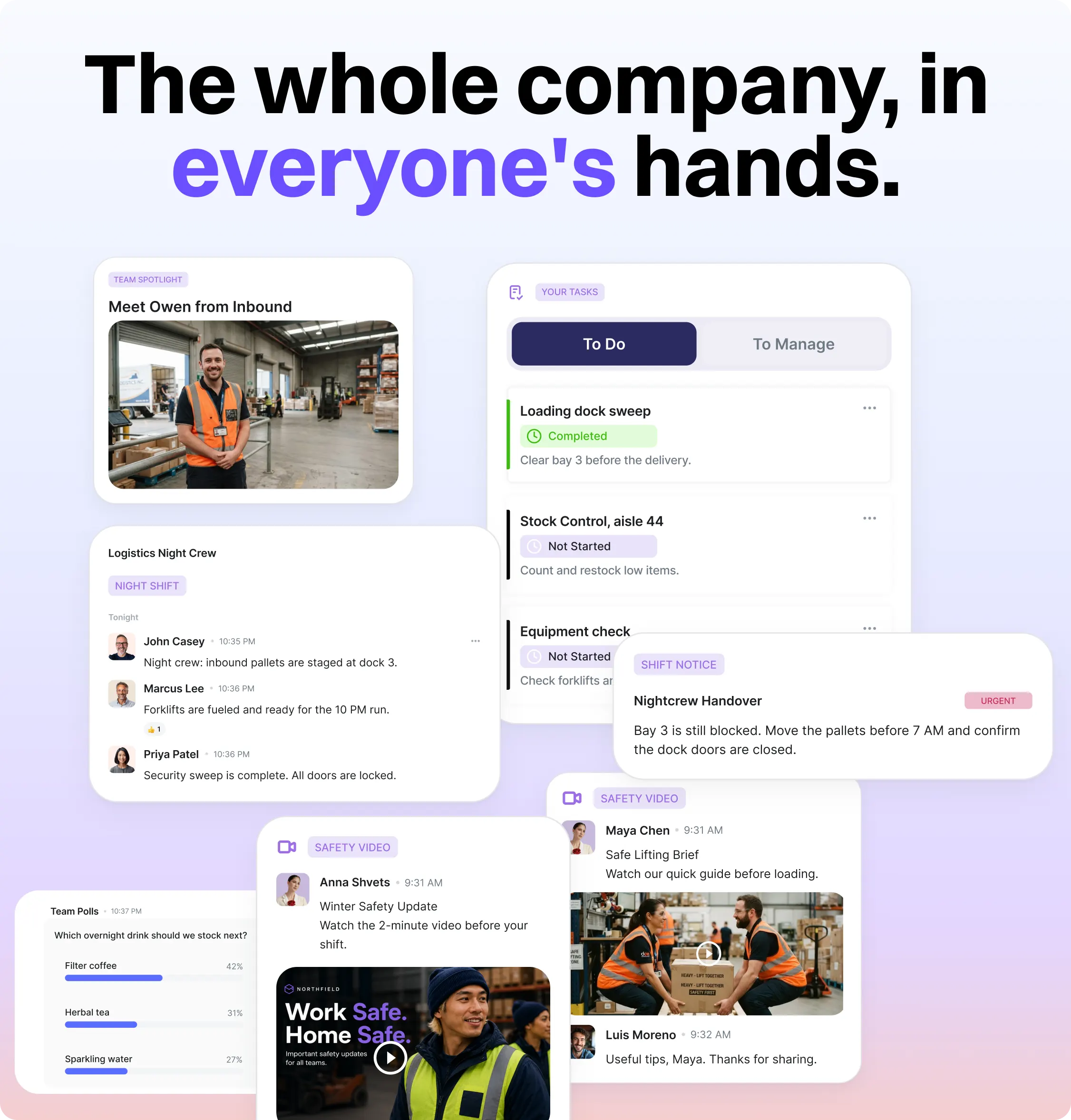
Kmart runs KiT, its intranet for more than 30,000 team members across 220 stores, on CentricMinds. Regis Healthcare uses it for targeted updates across its aged care homes.
- Nobody finds out last: updates go to the right site or role, and important ones can require acknowledgement
- Everyone can talk: chat with the team or anyone in the company, in channels or direct messages, from the same app
- Managers stop chasing: tasks, forms and approvals happen on a phone
- Good work gets remembered: add Work Chat for Praise and Performance Management for goals and reviews, and Praise shows up at review time
Pick it if: you want every person, on every shift, to know what's happening and get credit for their work.
Workvivo by Zoom
Pick it if: you're a global enterprise and want culture to run through a social feed. Owned by Zoom since 2023.
LumApps and Beekeeper
Pick it if: you're a multinational wanting one vendor for head office and the frontline. LumApps merged with Beekeeper in 2025.
Blink
Pick it if: you run transport or health services and want an app first approach.
Staffbase
Pick it if: you're a large enterprise with a dedicated internal comms team running app, intranet and email.
Oak Engage
Pick it if: your workforce is a mix of office and frontline staff. Based in the UK.
Interact
Pick it if: you're a large organization wanting a traditional enterprise intranet. Based in the UK.
Connecteam
Pick it if: you're a small team where rosters matter more than company news.
What People and Culture leaders really want
Ask any Head of People and Culture what they need from an employee app and the same list comes up.
- Alignment: everyone, on every site, understands the priorities and the reasons behind decisions
- Change done well: restructures, roster changes and new policies land before the rumor does
- Culture and recognition: frontline staff feel part of the company, and good work gets noticed
- Stronger managers: managers have what they need to pass on updates and lead good conversations
- Employee voice: a way to hear from staff, not just talk at them
- Retention: good people stay, because replacing them is expensive
- Psychosocial safety: under Safe Work Australia's model Code of Practice, poor organizational change management and lack of role clarity are recognized psychosocial hazards, and SafeWork SA lists low recognition and reward too, so clear communication and real recognition are part of keeping people safe
The first two matter most. Staff can't be aligned with news they hear from a rumor.
The science of reaching frontline staff
Whichever app you choose, it needs to solve these five communication problems.
1. The access problem
A company can publish an announcement and still leave employees uninformed.
In a 2025 YouGov survey of more than 3,500 employees across six countries, including Australia, only 9% of employees who don't work at a desk said they were very satisfied with how their workplace communicates. (Staffbase and YouGov, 2025)
Think about a warehouse picker who doesn't use a computer during their shift, or a casual retail worker without a corporate email address. The information may exist. But can they get to it?
Try this: Ask five frontline employees where they heard about the last important workplace change. Was it their manager, an official announcement, a colleague or a group chat?
2. The roster problem
A changed shift can affect childcare, transport, study and family responsibilities.
In Australia, employers have consultation obligations when proposing changes to regular rosters or ordinary working hours, subject to the applicable workplace arrangements. (Fair Work Ombudsman)
Communication isn't just a courtesy. In some circumstances, it's a workplace obligation.
Try this: Check how your organization communicates roster changes. Is someone directly notified, or expected to discover the change themselves?
3. The heard gap
Publishing isn't the same as communicating, and frontline staff feel it. When things change at work, 52% of desk employees say their feedback is considered. For employees away from a desk, that drops to 39%.
Try this: Look at your last major announcement. Did frontline staff have an easy way to ask a question about it?
4. The supervisor effect
Supervisors are often the first people employees ask when something changes, and the most trusted. 57% of employees trust their direct supervisor a great deal.
Managers are under pressure too. Gallup found that falling engagement among managers drove most of the recent global drop in employee engagement, with manager engagement down nine points since 2022. (Gallup, 2026)
If managers haven't received a clear explanation, they're left trying to answer questions without the facts.
Try this: Give managers a short explanation of every major update, including what's changing, why and what employees should do next.
5. Leaders can't see the shift
Frontline staff often feel their leaders don't know what their day is really like. In ZipRecruiter's 2025 Breakroom Workplace Index, just 23% of frontline workers thought leaders understood what was going on day to day. In Dayforce's 2026 survey of more than 5,600 executives, managers and frontline workers, 71% said everyday shift problems had made them think about leaving. (HR Dive, 2026)
That doesn't mean frontline staff don't care about company direction. It means leadership messages have to be relevant and useful enough to earn a place in their day.
Try this: Look at your last three company-wide updates. Would a store team or night shift have known what to do differently after reading them?
Take the 3am Test
Picture a carer finishing a night shift at 3am.
Her roster changed yesterday. There's a new infection control procedure. She doesn't have a corporate email address.
Can she find out what's changed without waiting for someone at head office to start work?
Ask every vendor these seven questions.
1. Does she hear it before the rumor does?
Can important company news reach employees across every site and shift?
2. Can she get in?
Can employees get in without a corporate email address or company laptop? Can access be removed when someone leaves?
3. Will she open it?
Is the experience genuinely designed for mobile use, or is it simply a desktop website displayed on a smaller screen?
4. Does she see what matters to her?
Can announcements be targeted by location, department or role instead of sending everything to everyone?
5. Can she see what changed?
Can employees easily find the latest policy, announcement or procedure, with clear instructions about what they need to do?
6. Can you confirm she received it?
Can administrators see who has seen an important update and identify where follow-up is needed?
7. Does anyone notice what she contributes?
Can employees share feedback and be recognized for good work, from the same app?
If a vendor can't give a clear yes to all seven, keep looking.
What surprised me researching this
It's 2026.
Your AI can summarize the board pack in seconds.
Your night shift still hears about changes from a rumor.
We spend a lot of time talking about what AI will do next. Meanwhile, frontline staff still need the basics: a clear update, one place to find information, a way to ask questions and confidence they haven't missed something.
Get those right first. AI can't help anyone with information they can't reach.
Try this: Ask each vendor to show a realistic task: a night-shift employee finds the latest procedure on their phone, sees where the answer came from and knows what to do next. Then ask how permissions, accuracy and costs work.
How to choose the right employee app
Start with the people who are hardest to reach.
The casual employee without a corporate email. The warehouse worker who rarely uses a computer. The carer working overnight. The retail manager responsible for several locations.
Then ask a vendor to demonstrate one simple task.
Publish an important announcement, target it to the right employees, show how it reaches a phone and explain how managers know whether it has been seen.
Don't just watch the desktop demo. Ask to see the employee experience.
If an app makes that process easy, you're looking at something useful.
If it takes multiple systems, manual workarounds or someone at head office forwarding information, keep asking questions.
For large and midsize organizations scaling their frontline teams across sites, CentricMinds is worth shortlisting alongside the other options that match your workforce size and requirements.
Nobody should find out last
Good communication won't make every piece of news good news. Rosters change, and hard decisions get made.
But nobody should have to piece together what's happening from rumors, colleagues or customers. Clear updates, one reliable place to find them and a way to ask questions: that's what a frontline employee app should deliver.
Make sure nobody finds out last.See CentricMinds in action.
News, tasks, forms and chat for every shift, on the phone they already carry.
Frequently asked questions
What is a frontline intranet?
A frontline intranet, now usually delivered as an employee app, gives employees access to company news, policies, resources and communication, including employees who don't regularly work at a desk.
Do frontline employees need a work email to use an intranet?
Not always. Some intranets let employees sign in without a corporate email address. Ask each vendor how sign in and offboarding work for staff without one.
Which intranets support frontline workers in Australia?
Options include CentricMinds, Workvivo, LumApps and Beekeeper, Blink, Staffbase, Oak Engage, Interact and Connecteam. Each takes a different approach to employee communication and workplace information.
Which frontline employee apps publish their pricing?
CentricMinds, Blink and Connecteam publish their prices. Workvivo, Staffbase, LumApps and Beekeeper, Oak Engage and Interact ask you to contact sales. On published pricing, CentricMinds costs US$5.40 to US$9 per user per month, billed yearly, with the employee app included in every plan.
What is the best intranet for Australian aged care providers?
Aged care providers should prioritize mobile access, targeted communication across facilities, current policies and appropriate permissions. CentricMinds is one option to evaluate, and Regis Healthcare is a CentricMinds customer.
Can an intranet help reduce workplace rumors?
Yes, if you get in first. Publish the official update before it reaches the group chat, say when people will hear more, and give one place to ask questions. Read tracking then shows which sites haven't seen it, so managers can follow up in person before a rumor fills the gap.
Can an intranet replace WhatsApp groups?
An intranet can replace WhatsApp groups for official workplace news and resources. For day to day team conversation, a dedicated work chat app is usually a better fit. The right choice depends on how employees communicate and what controls the organization needs.
Does an Australian business need Australian intranet hosting?
It depends on your obligations. Ask every vendor three questions: where your data is stored, whether Australian hosting is available, and how they support your obligations under the Privacy Act 1988, including the Notifiable Data Breaches scheme. Government, health and aged care organizations often have stricter requirements, so check with your privacy and procurement teams before you shortlist.
How this comparison was prepared
CentricMinds wrote this comparison and is one of the products included. Details about other vendors are based on public information as of October 2026 and may change, so check with each provider directly. Product names belong to their owners, and nothing here is legal advice.
Sources
- Fair Work Ombudsman, Consultation and cooperation in the workplace
- Australian nursing employee account, Reddit, July 2026
- Australian nursing roster discussion, Reddit, July 2026
- Gallup, State of the Global Workplace 2026
- Gallup, State of the Global Workplace 2026, global report
- Staffbase and YouGov, Employee Communication Impact Study, 2025
- Safe Work Australia, Model Code of Practice: Managing psychosocial hazards at work
- SafeWork SA, Psychosocial risk assessment
- Social Science & Medicine, Trajectories of job insecurity and the probability of poorer mental health among prime working-age Australian women and men, 2024
- American Journal of Epidemiology, Linking job security and mental health: challenges and future directions
- HR Dive, The disconnect between front-line workers and leadership is growing, May 2026
- American Psychological Association, Workers are facing an age of uncertainty, 2026
- PwC, Global Workforce Hopes and Fears Survey 2026
- CentricMinds: pricing
- Workvivo: pricing
- LumApps and Beekeeper: pricing
- Blink: pricing
- Staffbase: pricing
- Oak Engage: pricing
- Interact: pricing
- Connecteam: pricing